
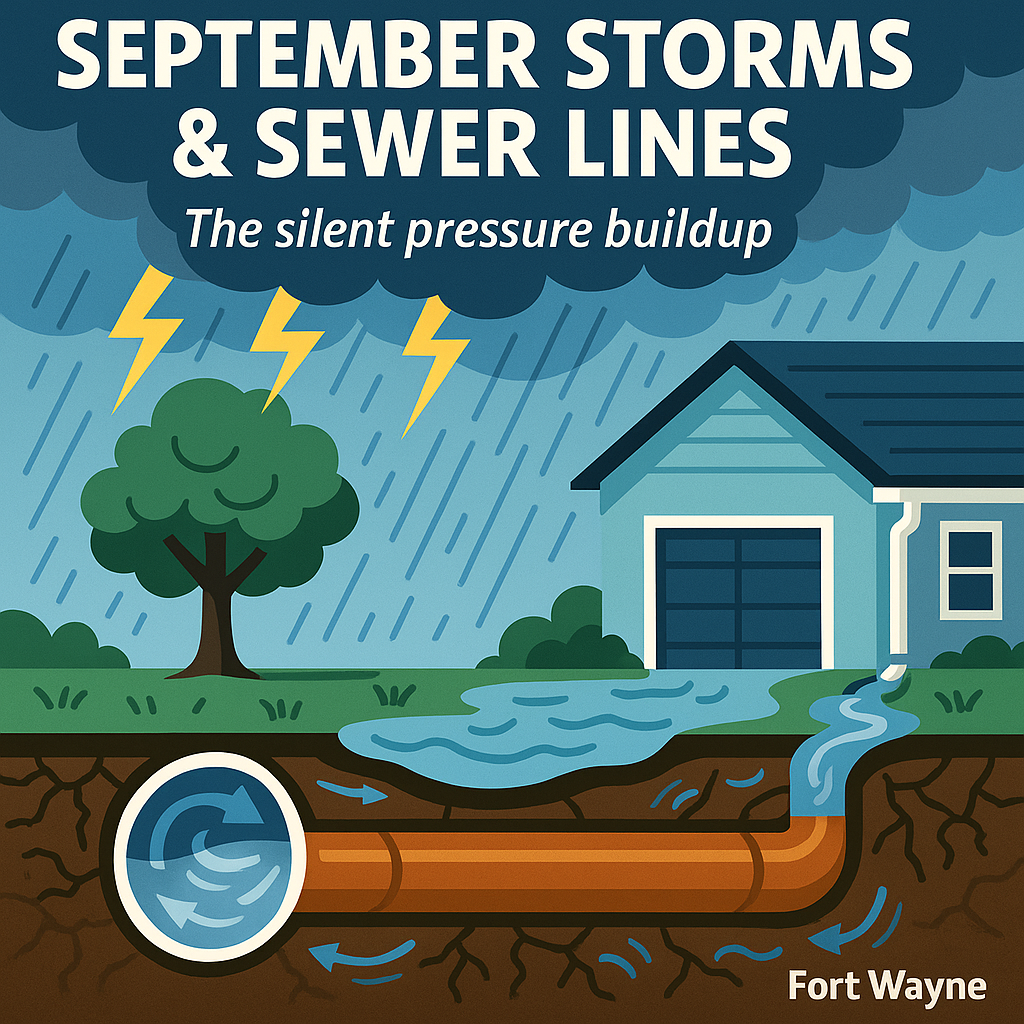
When September rolls into Fort Wayne, it brings cooler nights, football season, and — most importantly — a sudden shift in weather patterns. Late-summer storms often hit hard, dumping large amounts of water in short bursts. While this may seem like just another rain event, the impact on your sewer line is anything but ordinary.
Unlike spring rains, September storms often follow a long, dry summer. This contrast can wreak havoc on aging pipes and underprepared systems. In this expanded article, we’ll explore exactly why this time of year puts silent pressure on your sewer system — and what you can do about it.
1. Dry Ground Becomes Hydrophobic — Until It Doesn’t
After months of summer heat, the soil around your home becomes baked and compacted. This hardened soil can’t immediately absorb stormwater — causing fast runoff instead of infiltration. That means: – More surface water collects near your foundation. – Water rushes into storm drains and sewer laterals all at once. – Flash flooding and sewer backup risks spike dramatically.
Once the ground finally softens after repeated rains, the re-expansion of soil can shift pipes, break seals, and stress old joints in your lateral — causing cracks that weren’t there before.
2. Tree Roots Reactivate After Summer Dormancy
Trees in Fort Wayne often slow their root growth in peak summer heat. But by September, cooler soil temperatures and moisture reactivate root systems, and they start searching for water — aggressively.
If your sewer line has even a tiny crack, roots will: – Seek out the moisture from condensation and leaks – Invade the pipe through hairline fractures or weak joints – Expand inside the pipe, forming root balls that catch waste and cause clogs
Root intrusion can begin silently in September and become a full backup by October if left unchecked.
3. Sump Pumps Work Harder Than You Think
You might think your sump pump is only a springtime tool — but in Fort Wayne, fall groundwater rise is just as risky. As heavy rain saturates the yard and rehydrates the water table, sump pumps face: – Extended running time to keep water from pooling under the slab – Pump burnout risks if the float switch sticks or the check valve fails – Overflow if stormwater overwhelms your drain tile or basin
Many homeowners don’t realize their sump system is silently overworked until it fails during the next big downpour.
4. Hidden Cracks Expand During Temperature Swings
September may start warm, but Indiana’s nights get cold fast. The constant cycle of warm days and cool nights leads to expansion and contraction of both soil and pipe materials.
This fluctuation: – Worsens tiny cracks in clay or cast-iron pipes – Compromises plastic pipe joints – Triggers slow leaks that soften surrounding soil and attract roots
Eventually, this creates a perfect storm: weakened pipes, shifting soil, and excess water — all leading to a backup.
5. Stormwater Mismanagement Overloads Local Systems
In older Fort Wayne neighborhoods with combined storm and sanitary sewer systems, a heavy September storm doesn’t just affect your house — it can overwhelm entire street-wide infrastructure.
Here’s what happens: – Stormwater enters the sanitary system through improper connections or overwhelmed drains – Your home’s sewer line gets backpressure from downstream congestion – If your line has no backflow prevention device, sewage can push back into your basement
It’s not just about your own water — it’s everyone’s water, and one clogged system affects all.
What Fort Wayne Homeowners Can Do
Stay ahead of September’s sewer stress with these proactive steps:
✅ Schedule a sewer camera inspection — identify root intrusion or cracked joints early.
✅ Install a backwater valve — essential for homes with basement bathrooms or low drains.
✅ Redirect downspouts — move roof water at least 6 feet away from your foundation.
✅ Test your sump pump — check float switch, backup battery, and outlet. ✅ Clear yard drains and curb grates of leaves, mulch, and trash.
Final Thought: The Pressure Builds Quietly — Until It Doesn’t
By the time you see a backup, the damage is already done. September is the hidden trigger month — the perfect storm of dry-to-wet, root awakening, sump overwork, and temperature shock.
But with foresight and a little help from AAA Sewer Service, you can turn a vulnerable season into a sewer-smart one.
📞 Call AAA Sewer Service at (260) 456-6930 or visit www.aaasewerservice.com to book your inspection today. Let’s stop the pressure before it bursts.